Tag Archives: Greg Johnston

Shed Hunt Nets Bone, Memories

By Greg Johnston
AHT Guest Writer

I started the spring shed-hunting season hoping to find one set of sheds in particular – and no they weren’t from a 165” giant we’d been passing all year hoping he’d crack the Boone and Crocket barrier next season. This aint Iowa, and my name isn’t Lakosky.

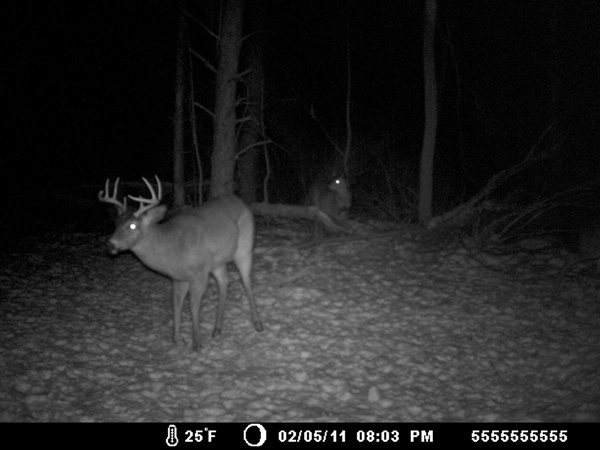
The deer whose antlers I coveted was a 2.5-year old 9-pointer, who frequented my Moultrie all winter long.

The 9-point buck Johnston awaited to drop sheds.

I religiously checked my camera waiting for this particular buck to show up missing antlers. In early February I got the photo I’d been waiting for. The buck I’d dubbed ‘Survivor’ showed up with his right side missing and a few hours later returned with no antlers at all.

In late February I set out hoping to stumble upon these two antlers.

It didn’t happen.

I made three different trips to the woods in February, but had no luck locating Survivor’s sheds in the thick white snow. My luck changed in March, though, when the snow pack melted and I was able to locate both sides of Survivor. The antlers lay approximately 25-feet apart in a travel corridor.

The author with his 3-year old son, Blake

This was a major accomplishment for me as this was the first match set of antlers I’d ever been able to recover.

Feeling more confident in my shed hunting ability, I took my 3-year old son a few weeks later to another family property. With Blake in the backpack, and my wife and daughter at the mall, we set off in hunt of more bone. For anyone with young children, this is a great way to get them involved in the great outdoors – and another opportunity to get you to the woods.

Sheds on the ground!


Blake seemed to really enjoy the day and even claimed he saw a zebra at one point. Not sure on that one.

We were about a half an hour into our quest when I spotted antlers through the woods. I pointed them out to Blake who replied, “They’re from a white buck Dad.” He could obviously see the white of the antlers through the trees. As it turned out there were two antlers and they too were a match set of sheds.

Blake looking tired after a day in the woods!


With two antlers in hand, Blake and I continued our walk where we found four more antlers. Nothing huge, but still satisfying – especially sharing it with my little guy who with any luck will roam those woods for years to come.

The walk back to the truck nearly broke my back, as the 35-pound kiddo was getting heavy after our long journey. He posed for some pictures, but fatigue had apparently caught up him too!

The shed season turned out to be an entire success. I substantially added to my shed collection and, more importantly, made some quality memories with my favorite little guy – memories that even a 165” deer can’t compare to.


The Hit-List Buck Falls

By Greg Johnston
AHT Guest Contributor

Grandpa always said he’d rather be lucky than good, but on opening day of the New York firearms deer season, I was a little of both.

Rewind one week to Nov. 13 when my hunting pal, John Koska, and I were hunting my family’s property in Livingston County.

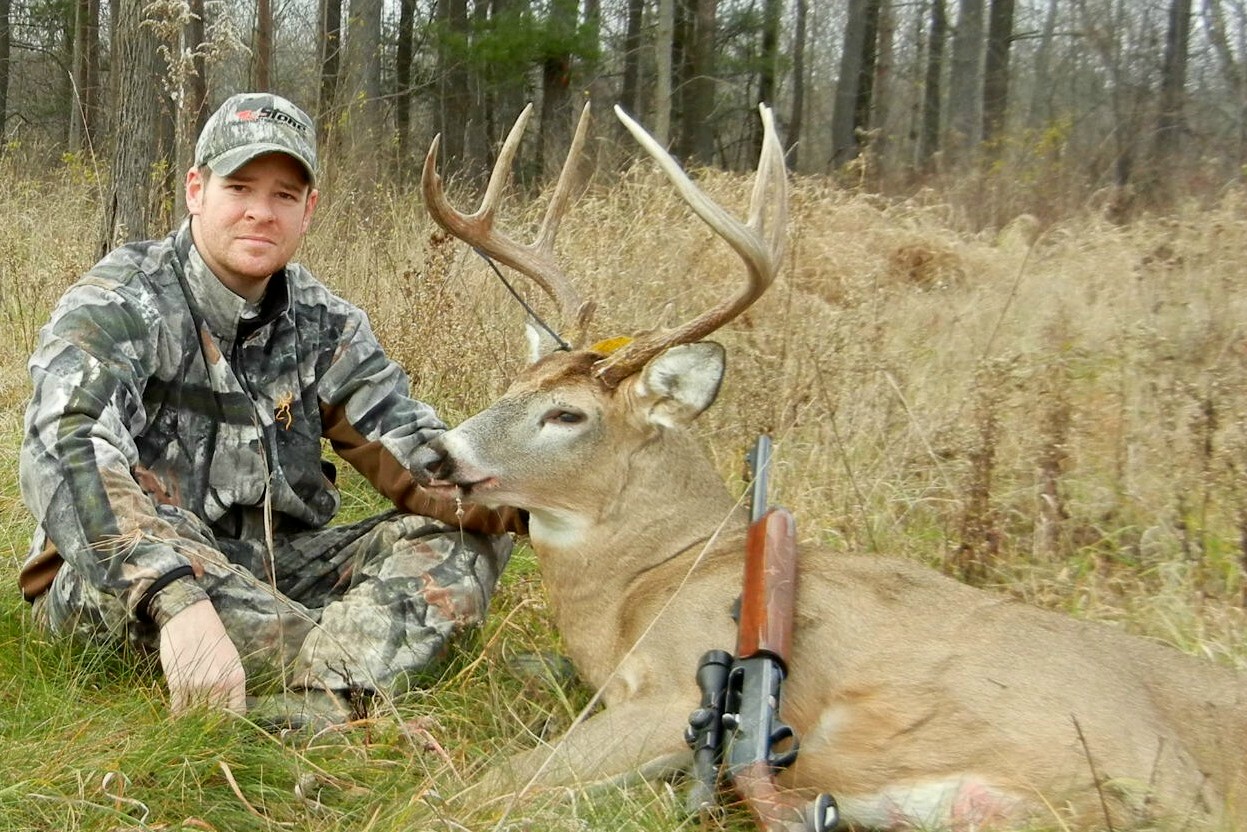
The author with his Great 8 2010 NY buck


It wasn’t long into the hunt and I felt the vibration from my phone in my safety vest. The message was clear and to the point: “Shooter chasing a doe.”

After a short while John gave me a call and said he watched the buck breed the hot doe and then work past the treestand with the doe at about 25 yards. John said the doe trotted through the shooting lane and that the buck had followed. Not feeling comfortable trying to squeeze a Carbon Express arrow through the young saplings, he elected to pass the questionable shot. You have to respect that.

My question to him was “where did the buck go?” He answered “west,” and that gave me an idea. I had a treestand at the bottom of the hill where the buck seemed to be working towards and with the doe in heat I was confident he wouldn’t go far.

It took multiple encounters for this mature buck to fall

So, I packed my gear, climbed down from my stand and hiked to the truck. From there I drove around the block where I planned on entering the same block of timber, but from the west side. It’s probably about 9:30 a.m. or so at this point.

I eased up the hill and reached the stand. Once settled, I could see a flurry of activity up the hill and it wasn’t long before several does worked by. I then caught a flash of something running and knew that mature buck was exactly where I anticipated he’d be. This meant two things: First, I’d positioned myself so the shooter was now in between John and me; and Second, I was now in a position to try and kill him.

With the help of my 10x42s I could see the brute laying into a tree about 90 yards away. I watched for a few minutes and examined him. “Man, he’s got cool-looking bladed main beams,” I thought.

What now?

I decided to grunt – all while watching him through my binos. He didn’t react, so I became more aggressive with a snort wheeze. At this point I realized it wasn’t meant to be. There is no replacement for love and this bad boy was in it.

At 12:30 p.m. I called it quits, as my son’s birthday party was the next day and I had to tend to some household chores.

With that, I hung up the Bowtech for another year and headed to work for the week, waiting for the following Saturday – the opening of firearms season – to roll around.

John and I talked and decided that the “Great 8” had leapfrogged his way to the top of the hit list.

On opening morning, I was carrying my Remington 1100 Special 20 gauge and entered the woods just hoping that I’d have a chance at the buck – or at least a mature buck. The morning hours came and went with many shots fired, but none from inside the perimeters of our property.

I backed out for lunch and John, my Dad and I discussed the afternoon hunt. After a sandwich, we were back at it. I reached the stand around 2 p.m. and settled in. Shortly after, a doe and yearling worked by. From there it gets a little blurry, because I dozed off in the stand. What? You’ve never done that? Whatever…!

Okay, after my cat nap I awoke to a much calmer woods. The wind, which had been stiff out of the west, had faded and the conditions had improved.

I sat and texted back and forth with John as he was hunting a stand in the middle of our property. It wasn’t long after that I caught movement to my right. Guess who? At 85 yards I struggled to find a clear lane to squeeze a Berennke through. That is until he stopped to work a scrape. I steadied my recticle on him and fired.

Bang.

The deer whirled, ran 10 feet and stopped. Bang. I fired again. This time, he went on a dead run through the woods, but angling towards me and closing the distance. I knew the second shot had hit him, but I wasn’t sure where.

I begged him to stop. And at 60 yards my recent string of bad luck ended as he applied the brakes. Bang. I shot a third time and with that he disappeared over the nearby gully.

So, you’d rather be lucky than good? Grandpa was right! Me too. That third shot had found its mark and entered his front shoulder.

I waited awhile and eased my way along the edge of the gully. What I saw at the bottom of the gully was the end of a lengthy, season-long quest. The “Great 8” was down! I stood at the top of the bank for 10 minutes or so collecting my thoughts before descending down to put my hands on him.

I couldn’t believe it had happened. I called John and told him the news. He was pumped and made his way over for the celebration.

Now my problem was talking my wife into another taxidermy bill. It’s like Dierks Bentley sings: Man what was I thinking?


Johnston’s Take: Unethical to Farm Raise Whitetails

By Greg Johnston
AHT Guest Contributor

Don’t get me wrong. I’m not a tree hugger. I burn wood, eat meat and enjoy killing God’s great animals for sport.

However, a recent trip to the New York Department of Environmental Conservation (NYDEC) left me asking this question: Is it ethical to raise, breed and grow whitetail deer for human benefit?

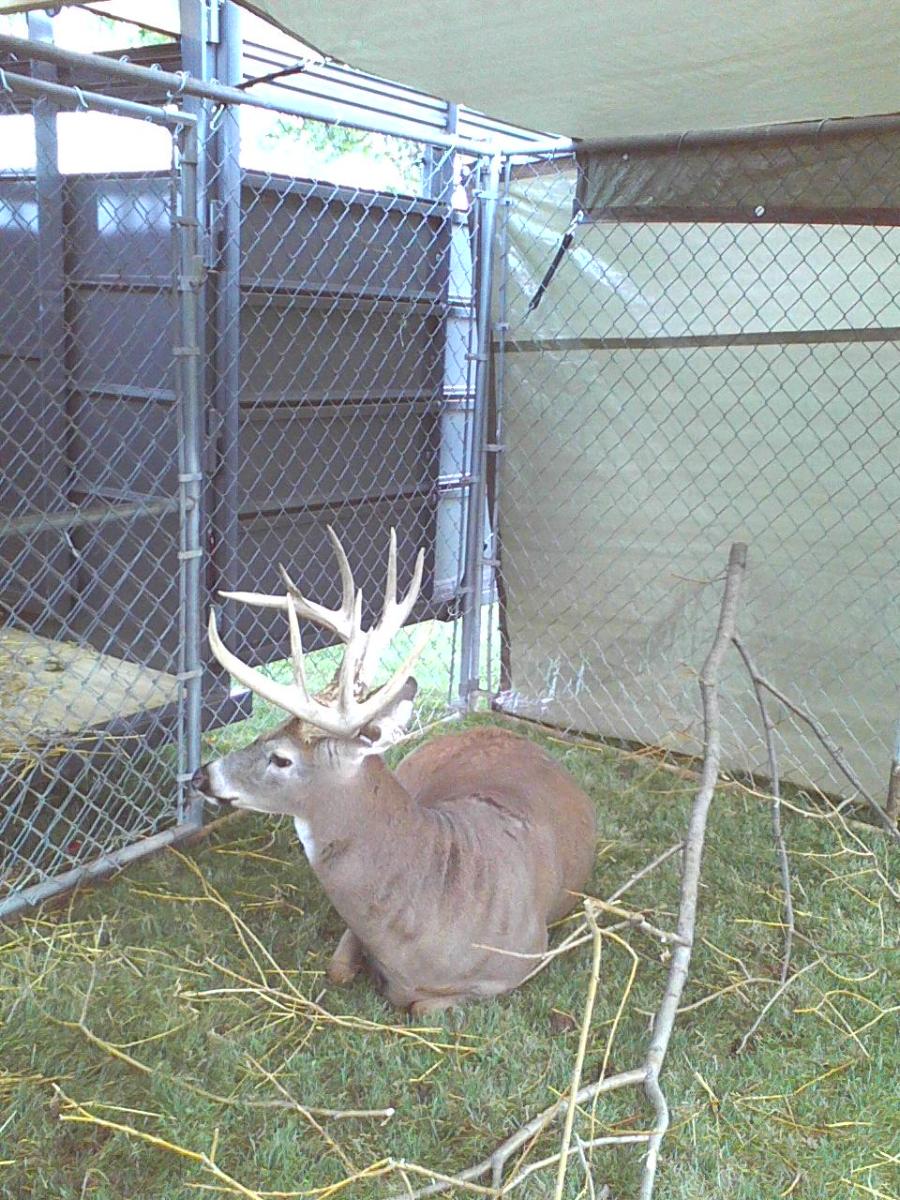
Photo of 170-class whitetail that spurred author's opinion of pen-raised whitetails


I say no.

Hunting ethics and sportsmanship are the core roots of our sport and without them where would we be? I don’t want to imagine.

To me, raising a wild animal for personal benefit crosses this line. Free roaming whitetails continue to be the No. 1 hunted big game animal in North America and this should give whitetails a free pass from captivity.

Let’s take the buck pictured in this post.

This was one of two trophy animals on display at the NYDEC event I attended. Although impressive to look at, I couldn’t help but wonder if the deer was enjoying the event as much as the dozens of gawkers who were looking at him.

For those of you unfamiliar with whitetail farming and its benefits, whitetails are grown and raised for one reason – money. Farmers either sell the animal for breeding stock [at a high-fenced facility] or collect their urine for scent sales. Either way, I’m opposed to it.

This hits at the heart of my argument. We’re not dealing with an Angus or an Appaloosa, here. The whitetail continues to roam free in all but five U.S. states – Nevada, Utah, California, Hawaii and Alaska currently have no published whitetail herds.

I’d like to see it kept this way.

I believe our Creator put the whitetail deer on earth for reasons unknown, but I’m pretty sure putting him in a pen wasn’t one of them.

Where do you stand?


Spot and Stalk Turkey Hunt Nets Bird, Memory

By Greg Johnston
AHT Guest Contributor

It wasn’t a promising start.

May 1, 2010 had come and gone without a single gobble on our 140 acres in Upstate New York.

Heading into the spring turkey season, my hopes were extremely high. I had seen multiple birds on a nightly basis during the fall archery season, and was even fortunate enough to harvest my first turkey with an arrow on our Livingston County property.

I didn’t have a good feeling about my dismal opening day, but if there was one encouraging fact, it was that I had only heard one shotgun blast echo down the valley during that calm Saturday morning.

Convinced that other hunters had experienced similar fates, I shrugged it off and headed home thinking that most toms had already found dancing partners for the spring prom.

When Sunday morning rolled around, I didn’t. I spent the morning with my wife and two young children, who I miss on most Sundays because of work obligations.

Monday brought a new week and new hope for me, but because of daddy duties, I wasn’t in the woods that morning either.

Nine o’clock came and that meant time to get my 5-year old off to school. We were two miles from the house and I happened to glance over, and there in a green field, was a strutting tom and at least one hen. I really didn’t think much about it, as my 2-year old was in the back seat and intent on spending the day with daddy.

That all changed though when I drove back by and saw Mr. Handsome still struttin’ his stuff. I couldn’t stand it anymore – I felt like a pot of cold water on a hot stove and I knew a pursuit would ensue.

Hard work and timely execution helped the author bag this Eastern turkey

Thinking quickly, I called our daycare provider to see if she could look after my little guy for a few hours.

By the time I dropped him off, I had roughly two hours of shooting time left, as high noon marks the end of shooting hours for turkey hunting in New York. Knowing the farmer whose field the bird was in, I stopped at the house to ask permission. He obliged and I was on my way.

My plan at this point was to get close enough to the bird and try to draw him away from his hen(s) by placing my decoy in a neighboring cut cornfield.

With a hedgerow separating me from him, I walked as far as I dared and set up on the edge of a woodlot. With my hen decoy bobbing in the west wind, I took a deep breath and then let out a yelp from my Primos diaphragm call. I waited, thinking the hot bird would for sure see the decoy and come in. But, that was far from what happened.

Thinking that the strong winds may be preventing the long beard from hearing me, I took out my slate call and gave a few strikes on it. Still nothing.

With time not on my side, I made a hasty decision to try and make something happen. Knowing that this would be my make-or-break move, I abandoned my decoy and slowly dropped back into the woods.

My hope was that I would somehow be able to gain ground on the bird while using the trees as cover.

As I crept towards the green field, the anticipation grew as I knew I was virtually on top of the bird. The question at this point though, was, “Where was he?”

I forced myself to move slowly as I feared a snapping twig would alert the bird and it would be game over.

When I reached the green field, I was astonished to see no turkeys. I thought,“You’ve got to be kidding me, right?”

I thought it was over, for sure. My thinking was that the birds had moved south prior to my arrival, however a glance through my Bushnell 10X42 binoculars proved my theory wrong.

There in the green field about 80 yards east of the hedgerow was a red head. I couldn’t believe it, not only had the bird not detected me, but he was still there.

Time to regroup.

With very little separating me from him, I needed to get behind a tree or something to ensure my presence wasn’t detected. I dropped to my knees and began to crawl down the west side of the hedgerow – using it as a buffer. I had a tree in mind that I hoped to make it to. From there I would set up and call – and for sure the bird would be able to hear me.

I made it. Tucking myself behind the mature walnut, I slowly reached for my favorite slate call. Little did I know, it had fallen during my approach.

I was forced to try and catch my breath for a minute and again using my mouth call, I let out a series of yelps, except this time I was watching his reaction through my Binos.

I couldn’t believe it; he turned his head and just sat there looking around. I let out another more aggressive call. Nothing. He wouldn’t budge. I knew he could hear me, because every time I called, he looked my direction. No gobble, no strut, no nothing.

With my bag of tricks empty and my decoy left behind, I questioned my next move. He’s about 60 yards from me at this point.

I gave a few more calls, to no avail. With my watch now reading 11:15 a.m., I had few options but to force the issue.

Slowly rolling onto my side I began to belly crawl towards the green field and the bird. I had pulled this trick off before some 15 years ago, but that time on a wounded whitetail. This time, I was dealing with an animal whose main defense was his eyes, and here I was out in the middle of a wide open field. For sure he would see me. But I had little options.

By the time I reached the green field, my arms began to burn, but my confidence grew.

As I entered a little swale in the field, I picked out a yellow weed in the clover, knowing that if I could make it to that point, my Harrington and Richardson single shot could do the rest.

The author displays the fruits of his labor. The bird weighed 21 lbs and sports a 9-inch beard and 1-inch spurs

I had reached the yellow weed without being detected, and in one smooth motion, I cocked the hammer on the 3-inch mag, came to rest on my knees and steadied my truglo sight on the red head. A swift squeeze of the trigger and the bird went down flopping. I ran up on him not believing I had pulled off the best spot-and-stalk of my life.

The bird weighed 21 lbs. with a 9-inch beard and 1-inch spurs. Not my biggest bird to date, but quite possibly my best trophy – or at least the most memorable one.

I hoisted the long beard over my back and headed home. It was about that time that I realized I had had crawled through a large patch of poison ivy along the way!